
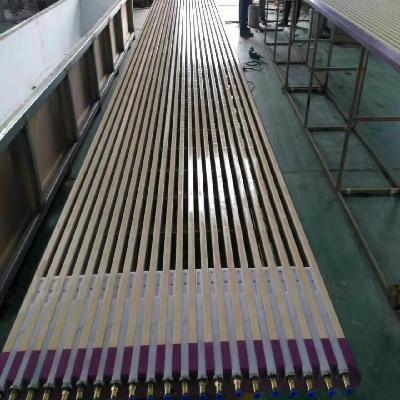
A Fourdrinier paper machine relies on a moving forming fabric to support the fiber suspension delivered from the headbox. As the stock travels along the forming table, water is removed through gravity, hydrodynamic pressure pulses, and vacuum-assisted drainage.
Different dewatering elements are installed in sequence to control this process. The mechanical interaction between the forming fabric, the stock, and the dewatering elements dictates both the drainage efficiency and the mechanical wear on the system.
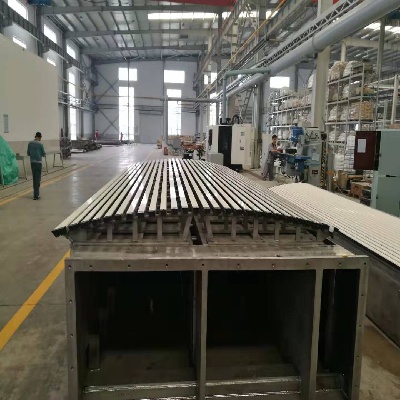
The forming board is located immediately downstream of the breast roll. Its primary role is to stabilize the stock layer and control initial drainage.
At this stage, the fiber network is highly fragile. Excessive drainage here causes a loss of fines and fillers into the white water system. This compromises sheet formation and can lead to two-sidedness. The blade width, spacing, and surface material must be carefully selected based on the headbox jet landing position and stock consistency.
Hydrofoils are designed with a leading support surface and a trailing surface. As the fabric passes over the foil, the geometry creates a localized pressure pulse—a combination of positive pressure at the leading edge and a vacuum at the trailing edge.
Foil Angle: A larger trailing angle increases the drainage action. However, an overly aggressive foil disturbs the developing fiber mat.
Progressive Staging: Use gentler drainage early on and increase the intensity as the sheet gains integrity.
Fabric Wear: Excessive hydrodynamic activity increases friction and accelerates fabric wear.
As the sheet develops integrity, vacuum-assisted dewatering becomes effective.
Wet/Low-Vacuum Boxes: Installed after the hydrofoil zones, these boxes bridge the gap to vacuum dewatering. The vacuum must be gentle to avoid sheet disturbance.
High-Vacuum Boxes: Used later to remove remaining free water before the Suction Couch Roll. The vacuum level must match the remaining water load and machine speed.
A critical operational error is applying uniform vacuum across all boxes. Excessive vacuum increases fabric drag, energy consumption, and wear without a proportional increase in dryness.
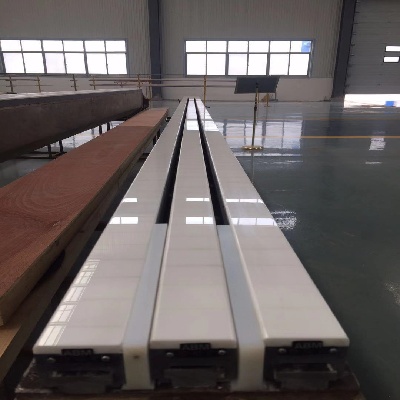
The choice of material for hydrofoil blades and suction box covers directly impacts maintenance costs and fabric life.
Alumina (Al₂O₃): High hardness and chemical stability. Commonly used for forming tables and suction box covers.
Silicon Nitride (Si₃N₄): Higher fracture toughness, suitable for demanding applications with impact risk.
Silicon Carbide (SiC): High hardness and thermal conductivity.
Engineering Warning: Hardness does not equal quality. A high-hardness ceramic with a poor surface finish, micro-cracks, or chipped edges will cause severe forming fabric wear. Inspection for flatness, edge finishing, and crack detection is mandatory.
UHMWPE offers low friction and impact tolerance. It is softer than ceramic and wears faster under abrasive conditions. However, it can be suitable for low-load applications or where fabric protection is the primary concern.
If your mill is struggling with dewatering efficiency, analyze the system step-by-step:
Evaluate the Drainage Profile: Identify if drainage is excessively concentrated in the early forming section.
Inspect Surfaces: Check forming boards and hydrofoils for uneven wear, chipped edges, cracks, and surface roughness.
Optimize Vacuum Distribution: Match the vacuum level to the sheet's development.
Check Fabric Tension and Alignment: Incorrect tension increases friction and wear. A new ceramic cover cannot compensate for a poorly aligned fabric.
Poor drainage doesn't just limit machine speed; it causes uneven moisture profiles and sheet defects. These issues often require targeted troubleshooting, such as the methods outlined in How to Solve Paper Wrinkling Problems.
For mills looking to upgrade their forming sections, HUATAO GROUP supplies a complete range of Paper Machine and Parts, including ceramic hydrofoils and forming boards.
Q1: What is the difference between a forming board and a hydrofoil?
A forming board supports the fabric and controls initial drainage at the headbox. A hydrofoil uses geometry to generate hydrodynamic pressure pulses further down the table.
Q2: Are ceramic hydrofoils better than UHMWPE hydrofoils?
Ceramic offers superior abrasion resistance. UHMWPE offers lower friction and impact tolerance. Selection depends on machine speed, load, and fabric compatibility.
Q3: Can increasing vacuum improve sheet dryness?
Only within the effective operating range. Excessive vacuum increases fabric wear and energy consumption.
Q4: Why do my forming fabrics wear out quickly?
Causes include damaged ceramic covers, excessive vacuum, incorrect tension, poor alignment, and abrasive contaminants.
Q5: Can I replace hydrofoil blades without changing the entire table?
In many cases, individual blades can be replaced. Mounting dimensions and foil geometry must be verified.
Q6: How does hydrofoil angle affect dewatering?
A larger trailing angle increases drainage action. However, an overly aggressive foil can disturb the fiber mat and increase fabric wear.
Q7: What causes ceramic covers to chip?
Impact from foreign objects, poor installation, or thermal stress. Chipped edges can cause severe fabric wear.
Q8: How do I choose between Alumina and Silicon Nitride?
Alumina is cost-effective for standard applications. Silicon Nitride offers higher fracture toughness for areas with impact risk.
Contact: Janet Wang
Email: janet.wang@huataogroup.com
Phone / WhatsApp: +86 17736903537
Website: http://www.papermakingtech.com
We warmly welcome customers from around the world to contact us and establish mutually beneficial partnerships.
can not be empty
can not be empty

HUATAO GROUP
ADD : No.298 Zhonghua North Street, Xinhua District, Shijiazhuang City, China.
TEL : +86 0311 80690567
EMAIL :market@huataogroup.com
Web: www.papermakingtech.com
Mobile: +86 18033763037 (  WhatsApp)