
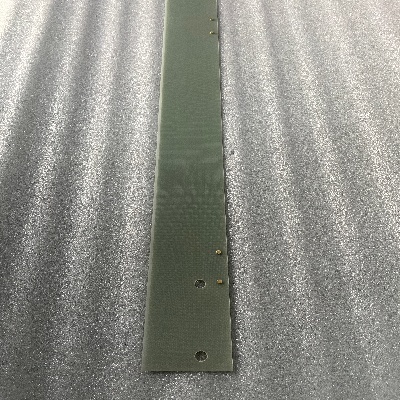
Doctor blades are essential consumables in the papermaking process. Installed against rotating rolls and cylinders, they remove water, fibers, pitch, stickies, and coating deposits. They are also critical for sheet shedding and roll surface conditioning.
Although steel and composite doctor blades perform similar functions, their material science and operating characteristics differ fundamentally. Selecting the wrong blade can result in rapid wear, roll scoring, or compromised sheet quality.
This technical guide analyzes the engineering differences between steel and composite blades, providing a framework for matching the blade to your specific machine position and operating conditions.
The doctoring system comprises the blade, the holder, the loading mechanism, and the shower system. The blade edge contacts the rotating roll to scrape away contaminants. The efficiency of this process is governed by the blade's stiffness, friction coefficient, and thermal resistance, as well as the roll's surface geometry and covering material.
Steel blades are manufactured from carbon steel, stainless steel, or alloy steel. Their primary advantage is high stiffness, allowing for aggressive mechanical scraping.
Carbon steel is standard for non-corrosive environments.
Stainless steel (e.g., 304, 316) is used where moisture or chemicals are present.
Coated metal blades (e.g., tungsten carbide) are used for extreme wear resistance.
Risk Profile: Steel blades require precise alignment and loading. If the loading mechanism is uneven or the roll covering is soft, the high stiffness of steel can quickly score the roll surface.
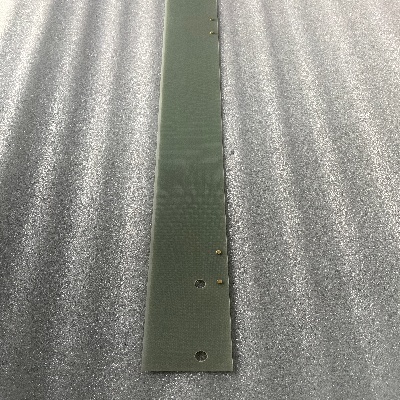
Composite blades utilize reinforcing fibers embedded in a polymer resin matrix.
Fiberglass Blades: Glass-fiber reinforcement with epoxy resin. They offer excellent cleaning and wear resistance, especially on dryer cylinders.
Carbon Fiber Blades: Carbon-fiber reinforcement provides low friction, dimensional stability, and long life at high speeds.
Glass-Carbon Hybrid Blades: Combine both to optimize stiffness, flexibility, and friction.
Engineering Note: The assumption that composite blades are always gentler on rolls is false. Certain glass-fiber grades or blades with abrasive fillers can be highly aggressive.
For related papermaking components, explore HUATAO GROUP Paper Machine Spare Parts.
| Comparison factor | Steel Doctor Blade | Composite Doctor Blade | ||
| Typical materials | Carbon steel, stainless steel, alloy steel | Fiberglass, carbon fiber, hybrid composites | ||
| Stiffness | Generally high | Depends on reinforcement and construction | ||
| Cleaning action | Strong mechanical scraping | Gentle to aggressive, depending on grade | ||
| Friction | Depends on steel grade, coating and lubrication | Low-friction grades available | ||
| Roll surface protection | Requires careful assessment | Suitable grades can reduce scoring risk | ||
| Wear resistance | Depends on hardness and coating | Depends on fibers, resin and additives | ||
| Corrosion resistance | Stainless grades offer improved resistance |
|
||
| Temperature resistance | Depends on alloy and coating | Limited by resin system and construction | ||
| Typical applications | Selected press, dryer and shedding positions |
|
Wet-end doctoring involves high moisture and soft roll covers. The primary objective is water and fiber removal without damaging the roll.
Suitable Materials: Engineered polymers, UHMWPE, soft composites.
Engineering Caution: Never use steel blades on polyurethane or rubber covers without OEM approval. Ensure the doctoring system is compatible with the Suction Couch Roll.
Press-section doctoring is complicated by wet sheet adhesion, stickies, and sheet transfer instability.
Suitable Materials: Carbon-fiber composites for low friction and stable release. Selected steel grades for heavy shedding.
Engineering Caution: Assess the roll geometry (smooth, grooved, blind-drilled). Ensure proper interaction with the Felt Suction Box.
Dryer cylinders are hot and prone to pitch and stickies buildup.
Suitable Materials: Fiberglass and carbon-fiber composites are standard. Carbon fiber is preferred for high speeds and long life.
Engineering Caution: The blade must withstand cylinder temperatures without resin degradation.
Calender rolls are highly polished and sensitive to friction.
Suitable Materials: Fine-grade composites or selected metals.
Engineering Caution: Aggressive blades will damage the surface finish, causing paper smoothness defects.
Blade service life is a function of material, loading, angle, and roll condition.
Factors Affecting Service Life:
Loading: Excessive loading increases friction and accelerates wear.
Angle: Incorrect angles cause unstable contact and chatter.
Showering: Proper lubrication reduces friction and flushes debris.
Roll Condition: Rough or corroded rolls accelerate blade wear.
Can Composite Blades Reduce Roll Damage?
Yes, when correctly specified. However, abrasive-filled composites can still damage rolls. Always verify roll hardness, covering material, and operating conditions before changing materials.
Poor doctoring often leads to roll surface degradation, which manifests as sheet defects like those outlined in How to Solve Paper Wrinkling Problems.
To select the right blade, provide the supplier with:
Paper machine type and production grade.
Installation position.
Roll material or covering.
Machine speed.
Operating temperature.
Doctor blade dimensions (length, width, thickness).
Existing blade material.
Doctor holder type.
Current cleaning problem.
Required service life.
Before requesting a quotation, inspect the holder alignment, loading uniformity, and shower system. For press-section cleaning and maintenance, review Paper Machine Equipment.
Q1: Are composite doctor blades always better than steel blades?
No. Composite blades offer low friction and roll compatibility, but steel blades remain superior for high-stiffness scraping and heavy shedding.
Q2: Which doctor blade material is best for dryer cylinders?
Fiberglass and carbon-fiber composites are widely used for dryers due to heat resistance and reliable cleaning.
Q3: Can a steel doctor blade damage a rubber-covered press roll?
Yes. Incompatible steel blades or incorrect loading can score soft roll coverings.
Q4: What is the difference between fiberglass and carbon-fiber doctor blades?
Fiberglass offers good cleaning and wear performance, while carbon fiber provides lower friction and longer life at higher speeds.
Q5: How do I know when a doctor blade needs replacement?
Watch for poor cleaning, uneven wear, chipped edges, vibration, and repeated deposit buildup.
Q6: What causes doctor blade chatter?
Chatter is usually caused by incorrect blade angle, uneven loading, or a worn holder mechanism. It can lead to rapid blade wear and roll damage.
Q7: Can I use the same blade on different roll materials?
No. Blade compatibility must be verified against the specific roll covering (e.g., rubber, ceramic, steel).
HUATAO GROUP has specialized in supplying pulp and paper machinery, paper machine equipment, and spare parts to customers worldwide since 2008.
Contact Huatao
Email: market@huataogroup.com
Phone / WhatsApp: +86 18033763037
Website: http://www.papermakingtech.com
We warmly welcome customers from around the world to contact us and establish mutually beneficial partnerships.
can not be empty
can not be empty

HUATAO GROUP
ADD : No.298 Zhonghua North Street, Xinhua District, Shijiazhuang City, China.
TEL : +86 0311 80690567
EMAIL :market@huataogroup.com
Web: www.papermakingtech.com
Mobile: +86 18033763037 (  WhatsApp)